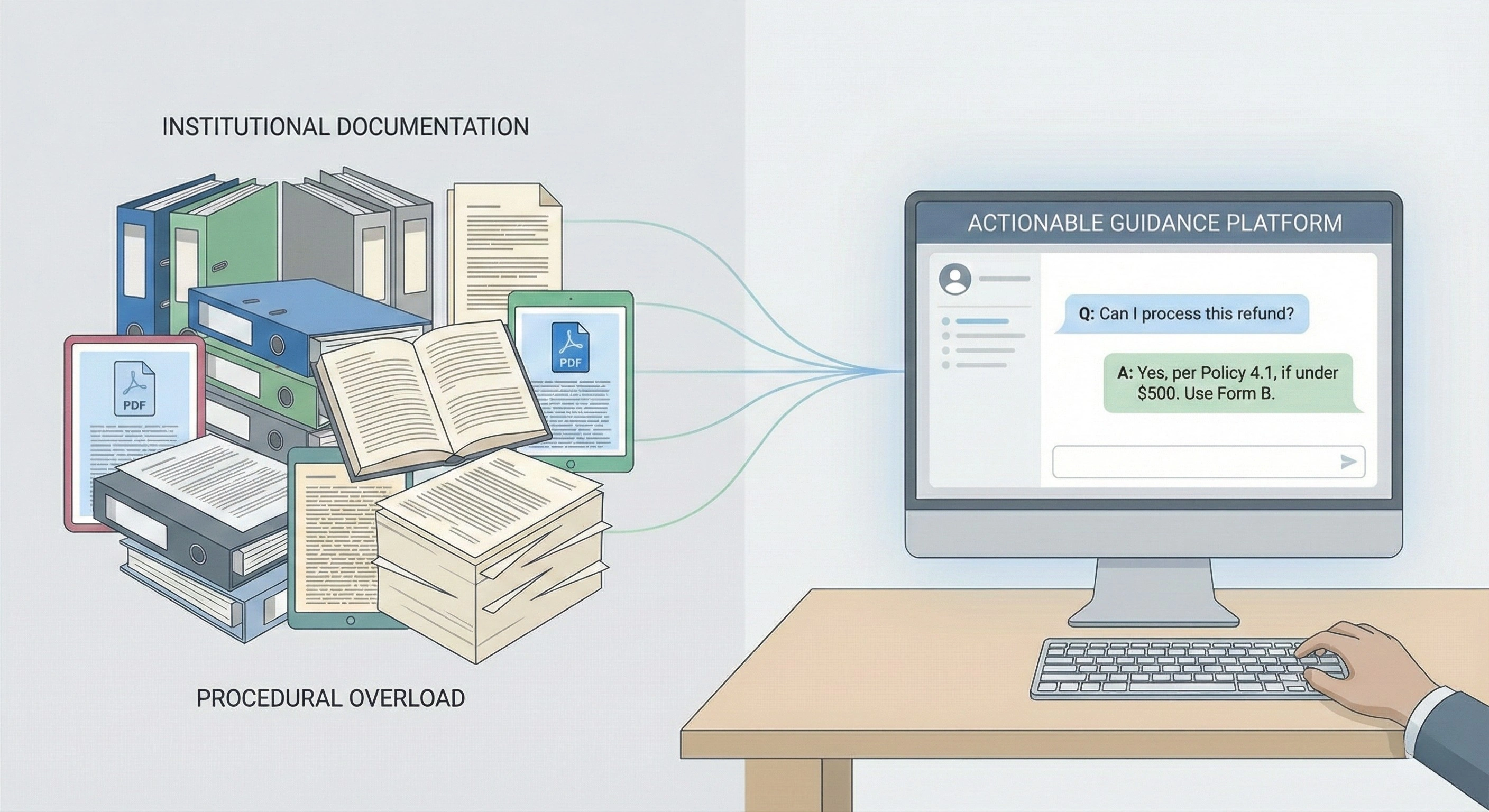
In regulated institutions, staff often spend more time finding the right policy or procedure than applying it. The documents exist, but they are scattered, versioned, and written for compliance rather than day-to-day decisions. The fix is to turn that documentation into searchable, contextual answers grounded in approved sources, so people get guidance the moment they need it without bypassing governance.
Institutions are buried under procedures, policies, and guidance. Decades of accumulated documentation live in shared drives, intranets, PDFs, and legacy systems. Staff are expected to interpret this material correctly while under time pressure, often without clarity on which version is authoritative.
This is where AI promises transformation but frequently falls short. An agent cannot act reliably if it cannot access clear, structured, and contextual guidance. Without usable procedures, agents either hallucinate, overgeneralize, or escalate unnecessarily. The result is risk.
Bespoke AI agents only create value when procedures are transformed into searchable, contextual answers. Instead of forcing staff to find documents, the system must surface guidance that is relevant to the question being asked, grounded in approved source material, and constrained by institutional rules.
When documentation is operationalized this way, AI becomes an interface to institutional knowledge. Employees can ask practical questions and receive answers that reflect policy intent, historical precedent, and documented procedures. This reduces friction without bypassing governance.
AI systems that operate outside the institution struggle to achieve this. External platforms rarely have access to the full body of internal documentation, and even when they do, that knowledge is often flattened into embeddings without context. What remains is searchable text rather than institutional understanding.
An internal AI solution can do more. It can respect document hierarchy, understand ownership, and prioritize authoritative sources. It can distinguish between guidance meant for reference and procedures meant for execution. Over time, it can reflect how the institution actually works rather than how policies were originally drafted.
The impact of properly executed internal AI solutions
- Staff spend less time searching and escalating.
- Second-level teams handle fewer routine questions.
- Knowledge becomes consistent across departments instead of fragmented by interpretation.
- Institutions reduce the risk that comes from inconsistent application of policy.
This is What Cognetryx Offers
Cognetryx was built around this reality. Our core product transforms internal documentation into agent-accessible knowledge that staff can rely on in real work. Instead of layering AI on top of documents, we design agents that operate within institutional context, using approved procedures as their foundation.
Turning procedures into searchable answers is the prerequisite for AI that actually works.
Ready to transform your institutional knowledge into actionable intelligence?
Cognetryx builds custom AI solutions that operate securely within your environment, turning decades of policies and procedures into knowledge your teams can actually use. Contact us today to discuss how we can reduce friction, improve consistency, and keep control where it belongs.
Request a Demo →