Ask where a regulated organization's AI lives and you will usually be pointed to a dashboard. A separate tab, a separate login, a separate place you go to ask questions. It is impressive in a demo. It is also, in practice, the wrong place for it to be.
Regulated work does not happen in a dashboard. It happens in the moment a clinician decides whether a medication order fits protocol, the moment an analyst decides whether a transaction alert warrants a filing, the moment a quality engineer decides how to classify a deviation. Those moments are where risk appears, where consistency matters, and where institutional knowledge is needed. They are also exactly where most AI tools are absent.
Point-of-work AI is intelligence delivered into the moment and place a decision is made, grounded in the institution's own governed knowledge. Not a destination you visit. A capability that meets the worker inside the task they are already doing.
What does "point of work" mean?
The point of work is the specific moment when a person has to act and the specific context they are acting inside. For a compliance analyst, it is the alert queue and the case file open in front of them. For a clinician, it is the order entry screen and the patient chart. For a quality engineer, it is the nonconformance record and the relevant procedure.
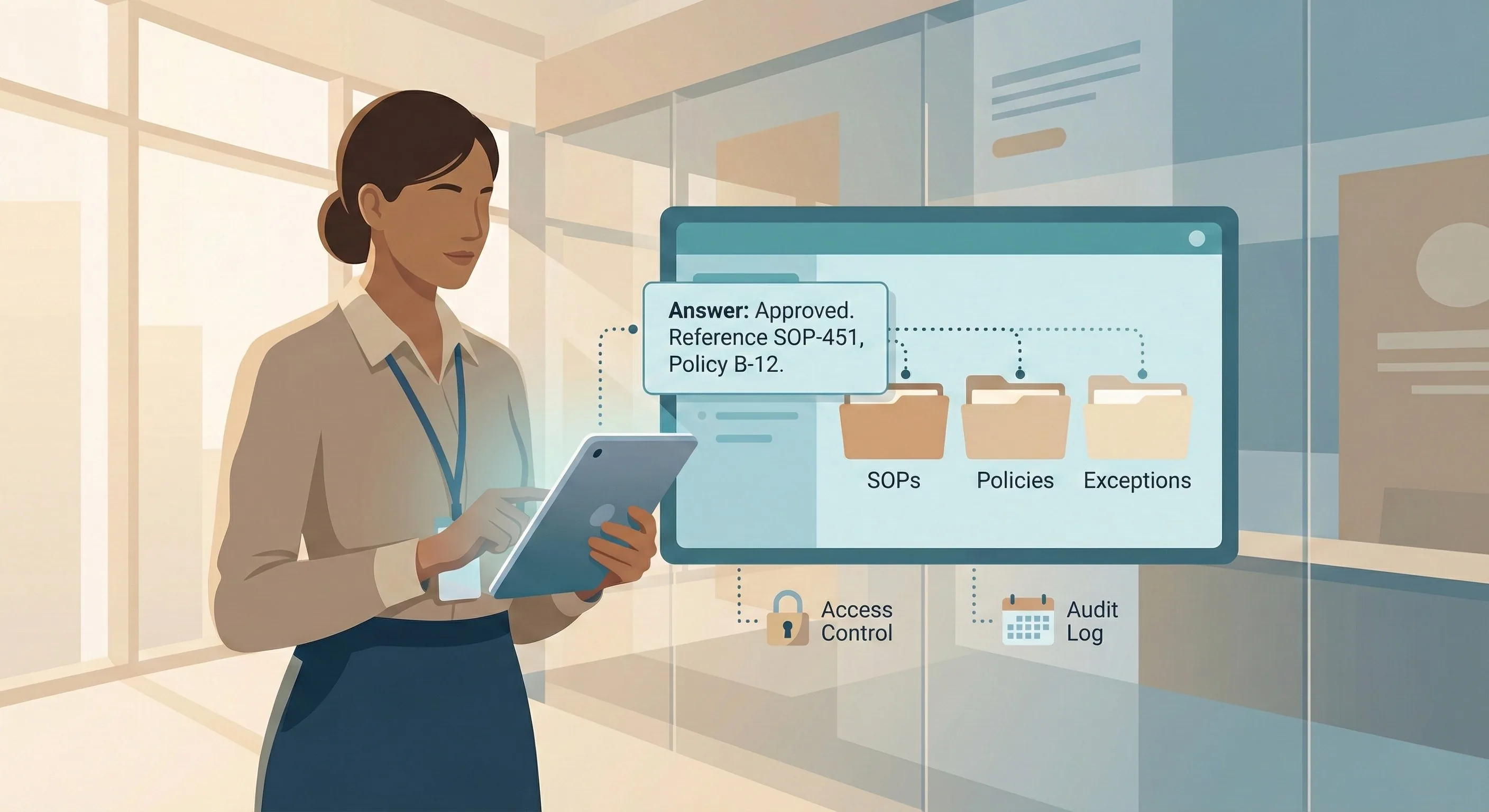
Point-of-work AI brings the relevant policy, precedent, and institutional reasoning into that exact moment, rather than requiring the worker to leave it. The test is simple: does the intelligence reach the person at the instant of decision, or does it wait in another tool for someone to come find it?
Why does the dashboard model fail regulated work?
The dashboard model asks a lot of the worker. To benefit from it, they have to stop what they are doing, switch context to another tool, formulate a query, wait for a result, interpret it, and carry the conclusion back to the decision they paused. Every one of those steps is friction, and under real time pressure the round trip usually does not happen.
So the tool that looked valuable in the demo goes unused at precisely the moments it would matter. This is not a failure of the model. It is a failure of placement. Intelligence that lives outside the flow of work does not change outcomes inside the flow of work, no matter how capable it is.
The most advanced model in the world changes nothing if the person making the decision has to leave their workflow to reach it. Placement is not a detail. It is the difference between an AI that gets used and one that gets ignored.
Three places the point of work appears
The pattern looks different in each regulated domain, but the structure is identical: a decision, under pressure, that depends on institutional knowledge the worker cannot hold entirely in their head.
In healthcare, the point of work is the clinical decision. A nurse or physician acting on an order needs to know how this institution's protocol handles this specific situation, not what a generic guideline says. Point-of-work AI surfaces the relevant internal protocol and prior guidance at the moment of the order, grounded in the organization's own approved documents.
In financial services, the point of work is the alert. An analyst deciding whether a transaction-monitoring alert becomes a filing needs the institution's own standards for similar cases, applied consistently. As we have written about in alert disposition and SAR decision quality, the examination risk is not the false-positive rate. It is whether analysts reason consistently. Point-of-work AI puts that consistent institutional reasoning into the case itself.
In regulated manufacturing, the point of work is the deviation. A quality engineer classifying a nonconformance needs to know how this site has historically interpreted the procedure, including the informal institutional judgment that never made it into a formal update. Point-of-work AI brings that history to the record at the moment of classification.
What point-of-work AI requires
Delivering intelligence into the point of work is not a matter of building a better chat window. It requires three things to be true at once, and all three are architectural.
First, the institution's knowledge has to be indexed and retrievable, so that the relevant policy and precedent can actually be surfaced. Second, the model has to run where that knowledge and the workflow already live, so the context can reach the decision without the data leaving the environment. Third, the same access controls and audit logging that govern human work have to apply to the AI, so that what it surfaces is governed and traceable.
Point-of-work AI is not a feature you add to a chatbot. Its value depends entirely on where the system runs and what it is grounded in. Intelligence grounded in a generic training set and reachable only in a separate tool cannot meet a regulated worker at the point of decision. Intelligence grounded in governed institutional knowledge, running inside the environment, can.
Why this is an architecture problem
It is tempting to treat placement as a user-interface question: embed a widget, add a sidebar, wire up an integration. But the reason most AI fails to reach the point of work is not that the button is in the wrong place. It is that the intelligence is grounded in the wrong source and runs in the wrong location.
An AI grounded in a public training set does not know how your institution interprets its own procedures, so even if you placed it perfectly, it would give generic answers to specific questions. And an AI that runs as an external service cannot be handed your sensitive institutional context at the point of work without sending that context outside your environment, which for regulated data is the deployment-model problem all over again. Solve placement without solving grounding and governance, and you have a well-placed tool that gives the wrong answers or creates a compliance exposure.
MIT's 2025 study of enterprise AI found that the initiatives that succeeded were the ones integrated into actual workflows, while generic, standalone pilots stalled most of the time. That is the same lesson from the other direction: AI delivers value when it reaches the work, and reaching the work is an architecture achievement.
Sources: MIT NANDA initiative, The GenAI Divide: State of AI in Business 2025, which reports that roughly 95% of enterprise generative-AI pilots failed to reach measurable business impact, with workflow-integrated deployments succeeding far more often than generic, standalone tools. National Institute of Standards and Technology, AI Risk Management Framework (AI RMF 1.0), 2023, on governance and traceability as conditions for trustworthy AI in operational settings.
Bring AI to the Point of Decision
Cognetryx delivers governed institutional knowledge into the workflows your team already uses, running inside your environment. The relevant policy and precedent reach the decision, not a dashboard nobody opens.
Book a Free AI Strategy Assessment →